by
Michelle Nott
Less than a half hour drive south of Brussels, tourists and Belgians alike arrive in the university town of Louvain-la-Neuve. In this pedestrian town, visitors rise from the underground parking lot of the Grande Place. And by the end of 2011, the Hergé fan will be able to walk a few steps over to the cinema to marvel (hopefully) at
Steven Spielberg's and Peter Jackson's cinematic portrayal of Tintin with all his friends. Until then, let's walk in the opposite direction, behind the shops to Rue du Labrador (previously Boulevard du Nord).
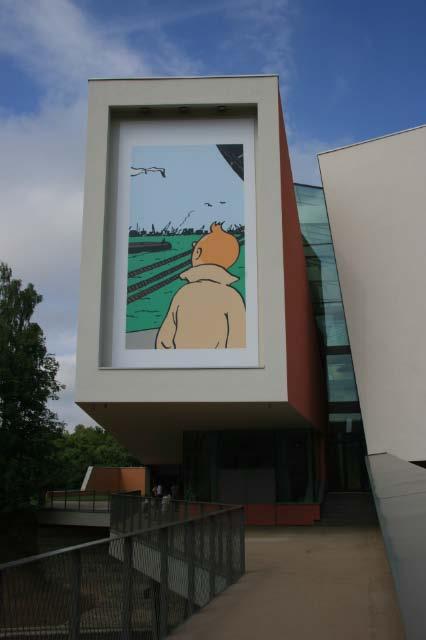
Down the bridged pathway, pedestrians face a mural of Tintin. But, he's not looking at them. His gaze looks ahead of himself, ahead of the crowd, forward and above. Each step accept sthis invitation and approaches until the painting is hovering over heads, until the visitor is peering up at Tintin in the exact position he is looking onward. Entering underneath him into le Musée Hergé, the Hergé fan, or soon-to-be-one, is not just in for a day-out. This is an adventure.
The museum is cleverly designed to bring the visitor into the world of Hergé's “bande dessinée” (comic strip in French). To begin, the museum patrons take the free audiophones available in English, French, Dutch, German or Spanish. They then enter the elevator. Fans will recognize the exterieur checkered design as the rocketship from Destination Moon (Objectif Lune, 1953). The doors slide open and the lift takes off to the third floor.
Boum! The music of Charles Trenet sways the visitors into the early 20th century. Not surprisingly, the artist and writer George Remi often incorporated music into his work, even in comic strip form. And Hergé? That is indeed him, his intials in the reverse order (RG) are pronounced in French as Her - gé.
Hergé started very young drawing in his notebooks, as so many young people do. As a boy, Hergé was a devoted Boy Scout. Understandably, his first strip is about a scout named Totor published in Scouts Catholique de Belgique. His scout days gave him a taste and love of adventure and camaraderie. Little Totor even experienced the U.S., traveling to Texas to meet his aunt and uncle which was interrupted by encounters with gangsters and American Indians. This first room of the tour is decorated with a history of Hergé's most beloved works, from Totor the Boy Scout (1926) to the street kids Quick and Flupke (1930) until Marlinspike Castle (Les Aventures au Château Moulinsart, 1963).
Hergé was an artist of many talents. The second room demonstrates Hergé's background in print, illustration, typography, and advertisements. Working in advertisements, he created “L'Atelier Hergé Publicité”. His experience in print ads gave him an appreciation for vivid colors but also white space and typography. All of which can be seen as influences in his own drawn strips.
From this rather dim room, the visitor steps out into the hallway, brightened (on a sunny Belgian day) by the large windows to the left. To the right, the visitor can peer down to the entrance hall and take in the impresive black-checkered design of the “rocket ship” elevator. The geometric walls are painted in a similar solid color pallette as in his albums. The same white birds, enlarged here, fly upon their two-dimensional sky.
The third room in the visit introduces Tintin's “family”. In glass displays, visitors can familiarise themselves with the main cast of characters. Descriptions and drawing from the different stories analyse each friend and foe distinctly. First and foremost, Snowy (Milou in French) is Tintin's faithfull partner. This particularly white fox terrier often comes out a hero in Tintin's escapades. For a good laugh, Thomson and Thompson (Dupont et Dupond in French) are the perfectly clumsy detectives who are just talented enough to pursue the wrong criminal. Professor Calculus (Tournesol in French) may have a hearing problem and be easily ditracted, but he is nonetheles a genius. Captain Haddock is the rugged yet tender partner. These traits paint him to be possibly the most human of all the characters, not to mention his appreciation for whisky. The one feminine touch to Hergé's series is Bianca Castiofore, the opera singer diva of the group. Visitors will continue to meet other characters as they proceed from here to the fourth room.
Spielberg was not far off target choosing to do a movie based on a Tintin comic book album. In fact, the manner in which Hergé created his adventures, square by square, can also be seen as similar to filmmaking. The visitor will discover how German science fiction movies and American film actors influenced the stories and characters in Hergé's strips, notably in Jo & Zette & Jocko. Also, Dupont and Dupond are not surprisingly similar to the other slapstick pair of the early 20th century, Laurel and Hardy. In fact, the black on white design accentuates the characters while minimizing the background to thin, fragile lines – all the better for comedic gaffs. This room proves Hergé's admiration for many aspects of film.
Continuing back through the “family drawing room”, the Hergé fans find a large chandelier directing the tour down a staircase. The immense light fixture is created by round portraits of 228 Hergé characters! A few couches and lamps decorate the area at the bottomof the stairs as well as a long murale of a New Year's greeting card made of all the personalities who can be seen throughout Hergé's repertoire. The audiophone presents an interesting explanantion of the composite of these characters.
A red carpet directs the visit into the laboratory. The patrons are face to face with the shark submarine from The Treasure of Rackam the Red (Le Trésor du Rackam le Rouge, 1945). In this particular story, Professor Calculus prouves himself to be far from the reputaion of an “absent-minded professor”, but of an actual genius. Throughout the laboratory, the guest learns that Hergé had the interest of bringing science to the level of the average reader. For example, in his way, he presented the notions of space and aeronautics in Shooting Star (1942) and Moon Objective (1953), respectively. He even went so far as to have the rocket model from Moon Objective approved by the scientific author, Ananoff, who published L'Astonautique in 1950. Hergé continues his pedagogical role to his public by eventually introducing Professor Calculus' “Tips and Tricks” column, explaining science to his youngest readers. The science behind the storylines then leads the visitors to the adjoining display of the artistic procedure and techniques behind his creations.
Back out on another red carpet, the museum patrons find a treasure of their own, like climbing into Tintin's attic or that of any child growing up with Tintin toys and games. Hergé took real relics (objects and/or photographs) from various places – the Congo, Egypte, China, Peru, Columbia, etc. - to inspire Tintin's adventures. Most of such objects were found in other museums, including the Louvre. The spirit of these objects or creative impressions of which have come full circle by finding a place in Hergé's museum. Reality, in this sense, enters fiction which in turn, encourages the discovery of truth.
From the bridge one floor up from the lobby, visitors are surrounded by the same geometric, pastel walls but now one floor down. Tall trees stand the heighth of the museum's three-story windows and the sunshine (on a sunny day in Belgium – and it was this day) brightens the visitor's path.
Studios Hergé is the next exhibit. The techinques, research, and history all involved in Hergé's creations come together here at the replicated desks of three of Hergé's associates, Bob De Moor, Jacques Martin and Roger Le Loup. Not only do Hergé fans get an idea of all the work and collaboration involved in producing a comic book album, but also all the fun. The audiophone and the description by various displays recount how Hergé would literally act out scenes for the other artists to draw. The author and artist dedicated years of himself to his literary and artistic endeavors. He not only created characters, but he grew as well with them. The evolution from Tintin in the Land of the Soviets (1929), for example, to Tintin au Tibet (1958) via The Blue Lotus (1935) illustrates for the reader an equal evolution in style and sensitivity – a natural human progression.
The final exhibit room is a tribute to the man born George Remi and remembered as Hergé. His personal character and heart made him one of the most respected and loved writers and authors of the 20th century. The testimonies of fans of all ages, of all walks of life, of all cultures attest to his importance for generations to come.
Le Musée Hergé
Rue du Labrador, 26
1348 Louvain-la Neuve
Belgium
tel: 0032. 10. 455. 777
Opening hours
Everyday 10 am to 6 pm,
closed Mondays, Jan. 1, May 1, Nov. 11 and Dec. 25
A special exhibit runs until February 27, 2011 showcasing trains in Tintin's adventures. By sitting in a wooden replica of a train car, patrons peer out windows portraying each a train scene from a Tintin story while watching a publicity video done by Studios Hergé in 1980 for the SNCB (Société Nationale des Chemins de fer Belges).

 Like any great art movement, Art Nouveau is a revolution against tradition. The “nouveau” aspect is influenced by several trends of the 19th century. The Pre-Raphaelites illustrated romantic, fantasy-like scenes with bright colors. Japonism produced flat, woodblock prints with no shadows. Symbolism went against naturalism and realism, creating spiritual, decadent, even morbid works of art. Finally, the aesthetic movement in design had itself also been influenced by Japanese lines and colors. Wrapping all these attributes together and picking out the most functional of each, Horta became one of the most amazing and acclaimed architects of his time...until WWI.